What Is the Difference Between RTA and Poker Bots?
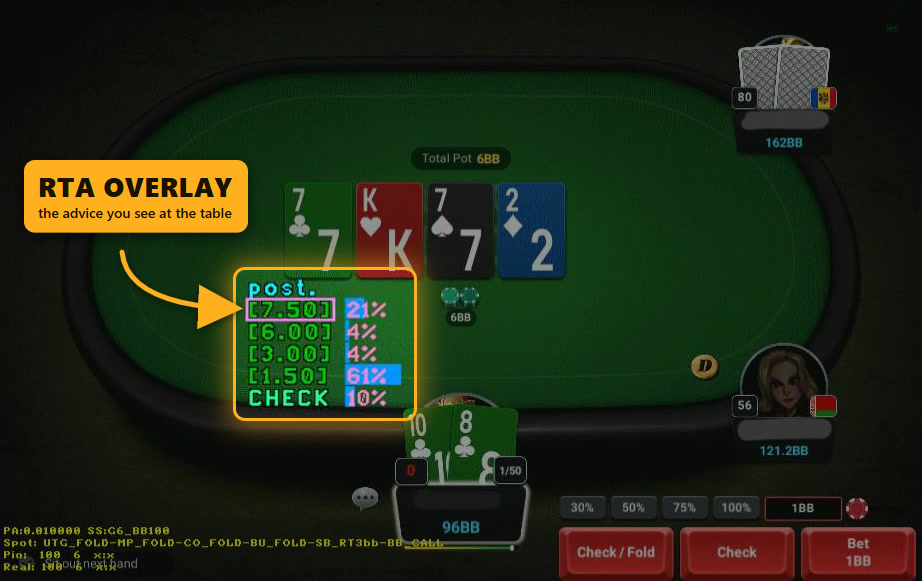
People often use "poker bot" and "RTA" as if they meant the same thing, but they describe different tools. A bot is a program that plays poker by itself. Real-time assistance (RTA) is a display next to the table that shows a player what a solver recommends and the player still makes every decision.
This article uses screenshots and video frames from the demo on our home page to show where the line sits in practice. It ends with a note on checking site rules and local laws.
RTA vs poker bots at a glance
| | Poker bot | RTA | | --- | --- | --- | | Who decides | The software | You | | Who clicks | The software, in the poker client | You, in the poker client | | What you see | Usually nothing, it runs unattended | An overlay with options and frequencies | | Needs a person at the table | No | Yes | | Can you disagree with it | No, it acts on its own | Yes, every decision is yours |
Most of the table comes down to who clicks. With a bot, software does. With RTA, you do.
What does a poker bot do?
A bot runs the whole loop without a person. It reads the state of the table, chooses an action with a strategy engine and clicks the buttons in the poker client. It can sit at several tables and keep playing for hours while nobody is at the computer.
Because nobody is making choices, bots tend to leave patterns. Their action timing is too even, they take the same line in the same spot every time and their sessions run far longer than a person could play. Poker sites watch for these patterns. Our article on [the rise of poker AI](/blog/poker-bot-evolution-rise-of-ai) covers how bots developed.
What is RTA?
RTA software works like a heads-up display. It watches the table, works out the situation and draws a small overlay with the available options and how often a solver would take each one. The player reads the overlay and decides.
The overlay has no buttons or controls. Every bet, call, fold and check still comes from the player clicking in the poker client. Our FAQ says the software is not a fully automated bot and that you make the decisions yourself.
Three examples from a real table
The screenshots below come from the demo image on our home page, which shows twelve No-Limit Texas Hold'em tables at once. In each one, the overlay is the small colored block on the felt. Each row is an option and the percentage beside it is how often the solver takes that option. The percentages in one block add up to 100. Amounts are in big blinds (BB) and player names are blurred.
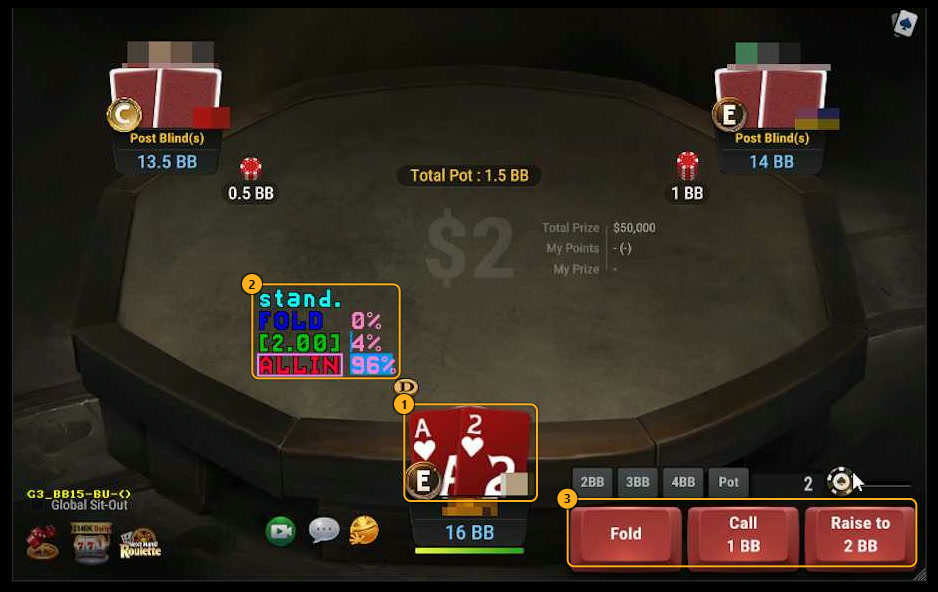
*Example 1: preflop, short stack.*
1. Your cards are A♥ 2♥. You are on the button with 16 BB and the other two players have 13.5 and 14 BB and have posted their blinds. 2. The overlay lists fold at 0%, a raise to 2.00 BB at 4% and all-in at 96%. With a stack this short, the solver pushes this hand almost every time. 3. Fold, Call 1 BB and Raise to 2 BB are the poker client's own buttons. You click these and the overlay has no buttons of its own.
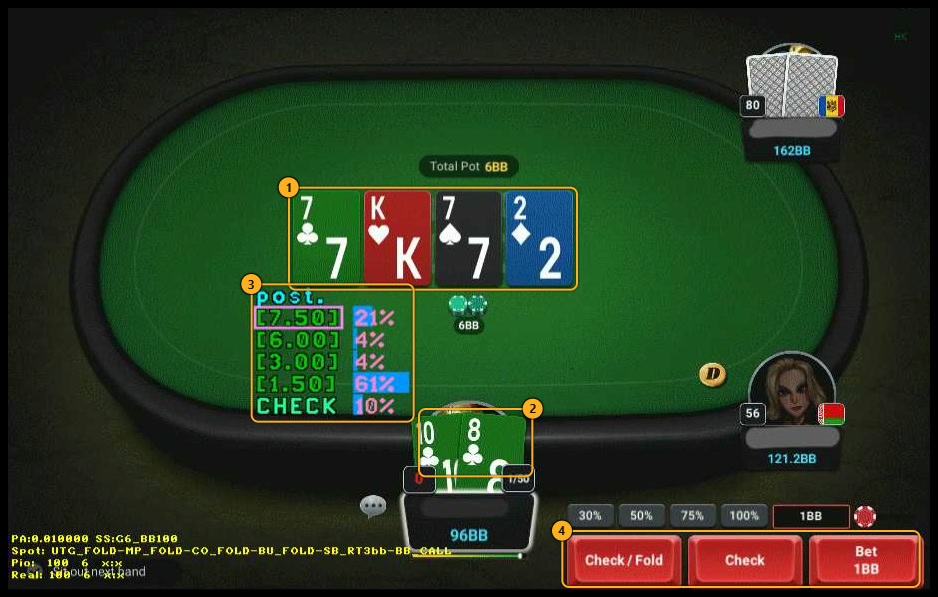
*Example 2: turn, mixed strategy.*
1. The board is 7♣ K♥ 7♠ 2♦ and the pot is 6 BB. 2. Your hand is 10♣ 8♣, which has missed the board. 3. The overlay lists bets of 7.50, 6.00, 3.00 and 1.50 BB, or check. The 1.50 BB bet, a quarter of the pot, takes 61%, the 7.50 BB bet takes 21% and check takes 10%. No single action is right here. The solver mixes between them and the overlay shows the mix. 4. Check/Fold, Check and Bet are the client's buttons. You choose and click.
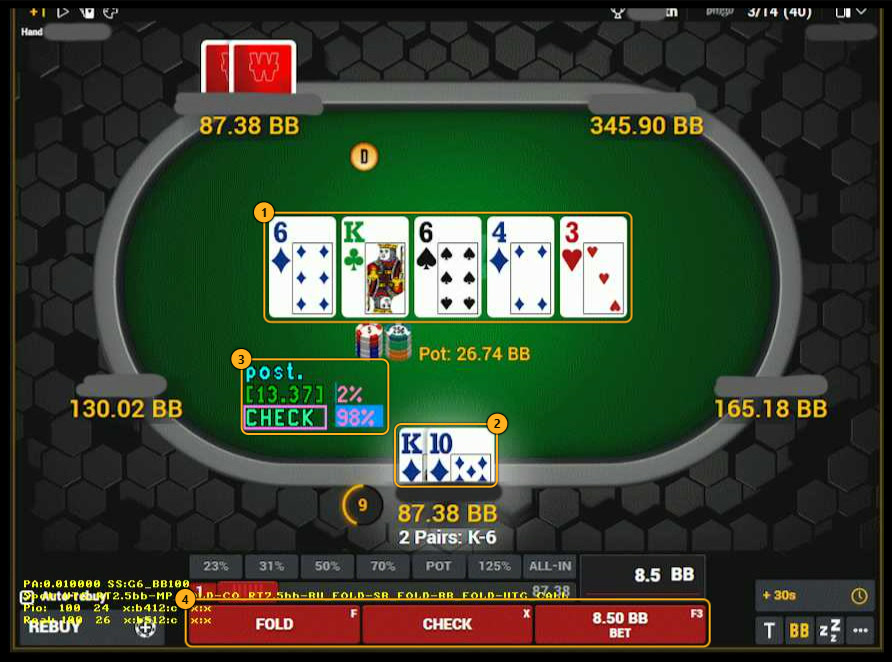
*Example 3: river, two pair.*
1. The board is 6♦ K♣ 6♠ 4♦ 3♥ and the pot is 26.74 BB. 2. Your hand is K♦ 10♦, which makes two pair, kings and sixes. 3. The overlay shows a bet of 13.37 BB, half the pot, at 2% and check at 98%. A strong-looking hand can still be a check. The overlay says what the solver does and does not stop you from doing something else. 4. Fold, Check and Bet 8.50 BB are the client's buttons. The bet size is whatever you set in the client.
What the demo video shows
The demo video on our home page follows one hand at a six-handed table, from the first raise to the last bet. Three moments from it show how an overlay differs from a bot. Stacks and bets are in big blinds.
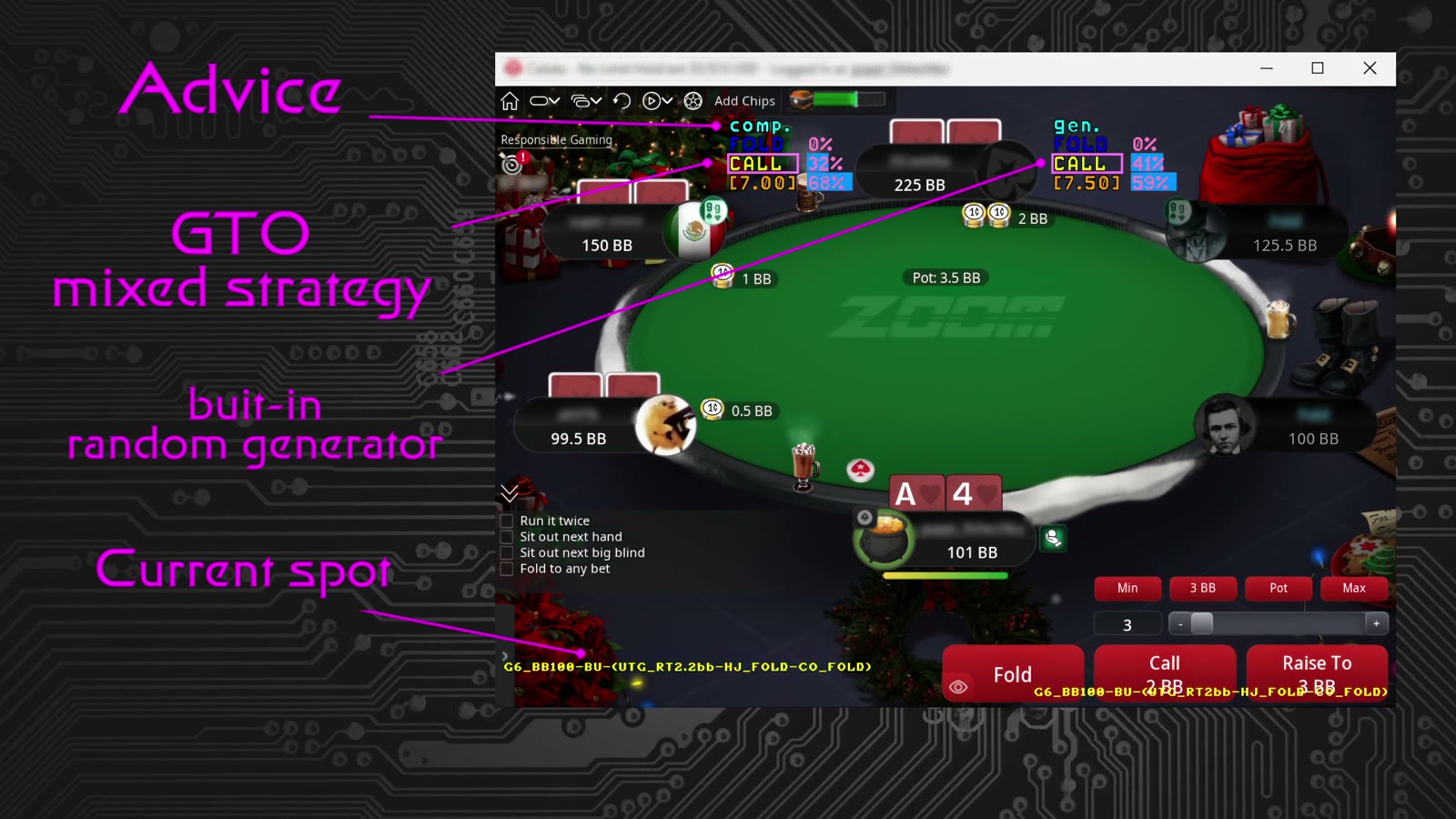
*The overlay appears on the table, with the video's own labels.*
The video labels the left block Advice and GTO mixed strategy. It shows fold 0%, call 32% and raise to 7.00 BB at 68%. The right block, which the video points to with "built-in random generator", shows fold 0%, call 41% and raise to 7.50 BB at 59%. The yellow line at the bottom is labeled Current spot. It describes the situation the software recognized: the player is on the button, UTG raised and the seats before the player folded.
Once the overlay is up, the player still has to act. The buttons along the bottom belong to the poker client.
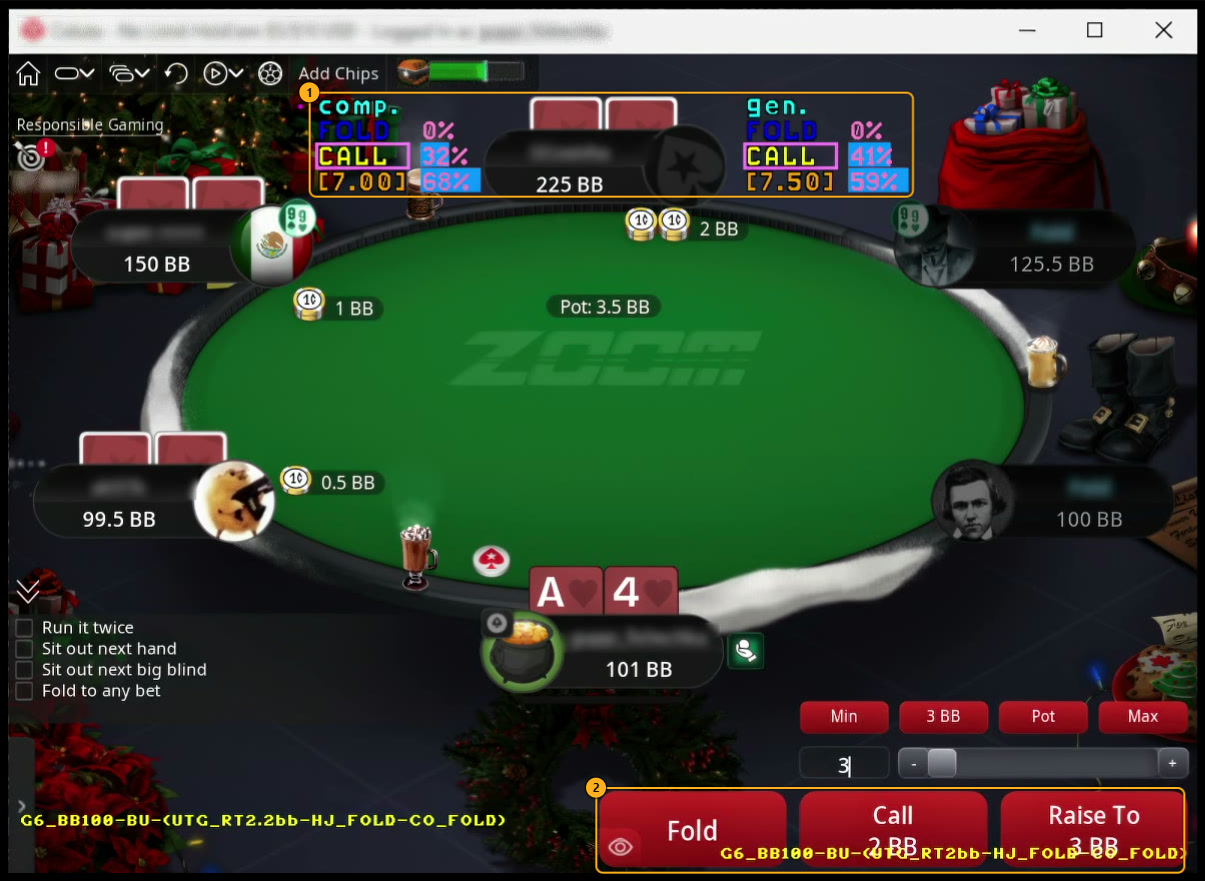
*The player's turn to act.*
1. The overlay's two blocks sit at the top of the table. 2. Fold, Call 2 BB and Raise To 3 BB are the poker client's own buttons. The overlay has none, so every action is a click on these.
Later in the hand the overlay lists six options on the flop.
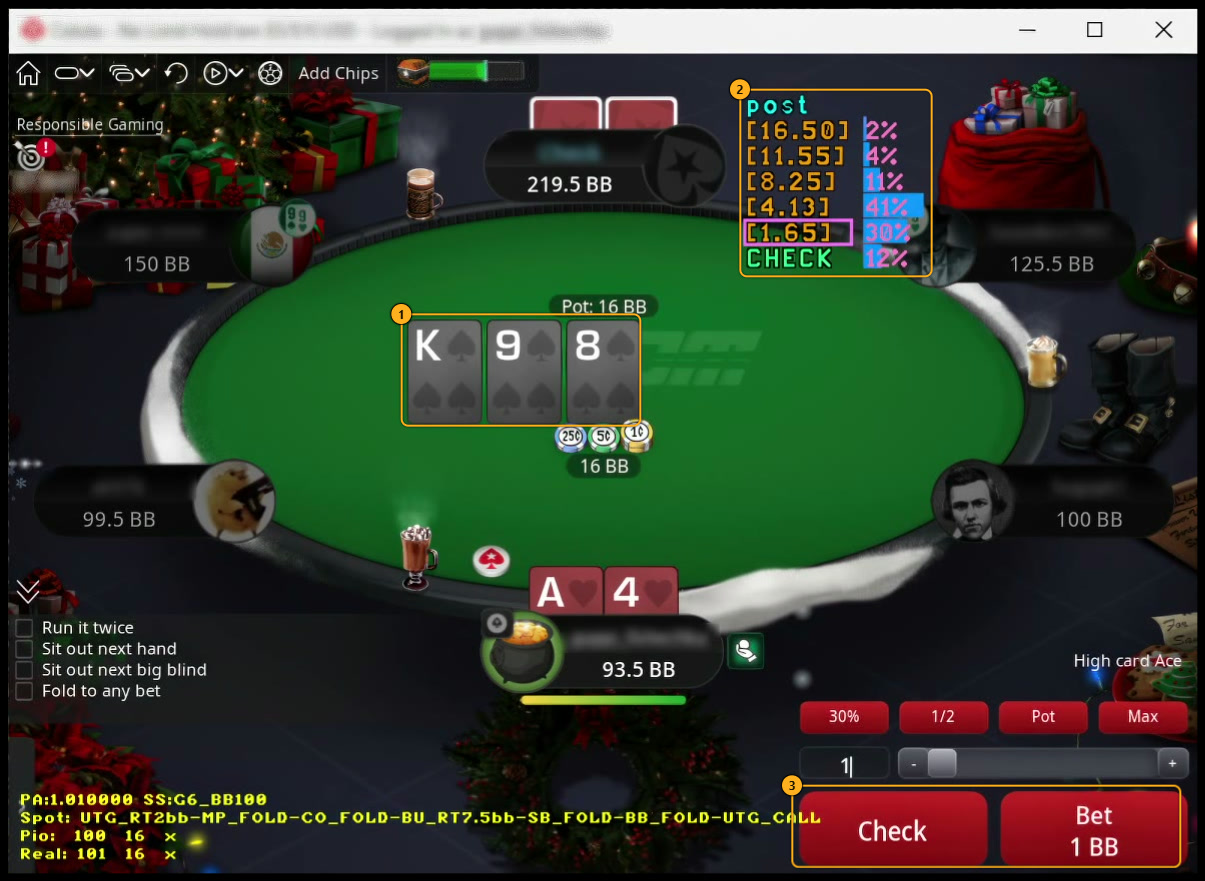
*The flop decision.*
1. The flop is K♠ 9♠ 8♠. The pot is 16 BB and UTG has checked. 2. The overlay shows bets of 16.50, 11.55, 8.25, 4.13 and 1.65 BB at 2%, 4%, 11%, 41% and 30% plus check at 12%. The bracketed numbers are bet sizes in BB. 3. Check and Bet are the client's buttons.
How the setup works
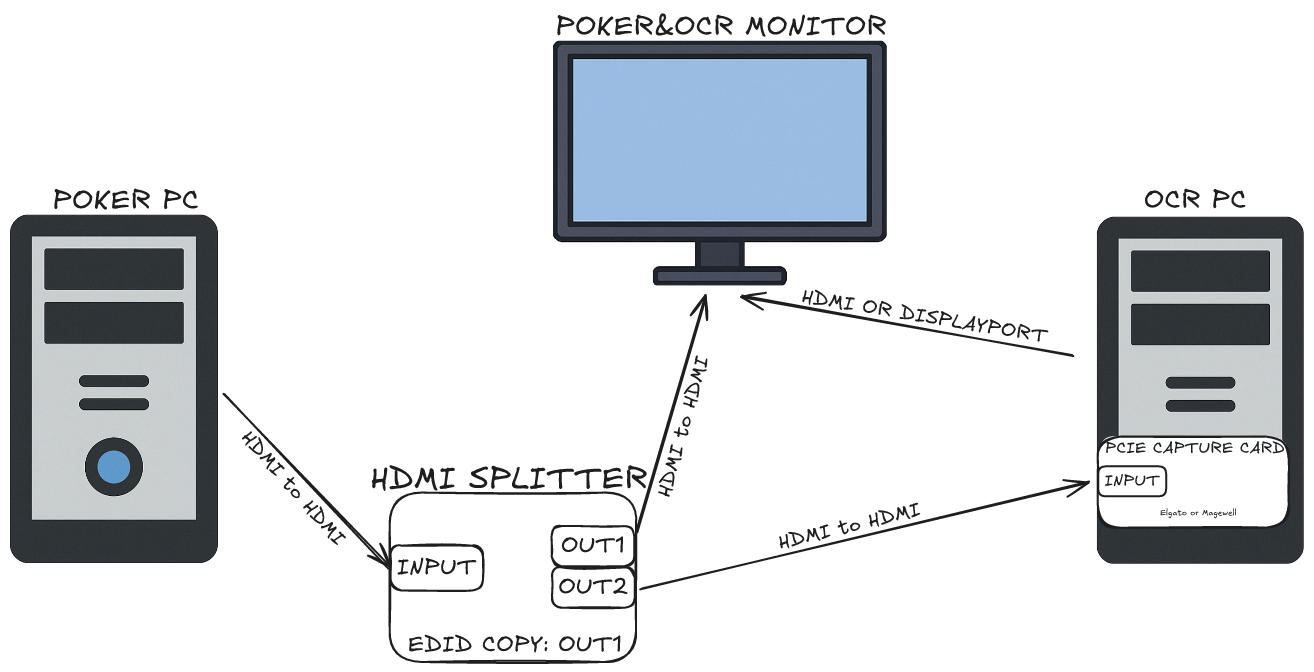
*Desktop setup with one monitor and a PCIe capture card.*
The poker computer runs the poker client and its video output goes into an HDMI splitter. One splitter output goes to the monitor you play on. The other goes into a capture card in a second computer, the OCR computer. OCR stands for optical character recognition: the second computer reads the cards, bets and stacks from the video image, looks up the solution and shows the overlay on a screen. In the setup above, both computers connect to the same monitor.
Follow the arrows in the diagram. Information runs from the poker computer through the splitter to the capture card. The OCR computer sends its picture to the monitor and nowhere else and no arrow runs back to the poker computer. The overlay is something to look at and acting on it is up to the player.
There are variations. With two monitors, the OCR computer gets its own screen. Laptops use a USB capture card instead of a PCIe card.
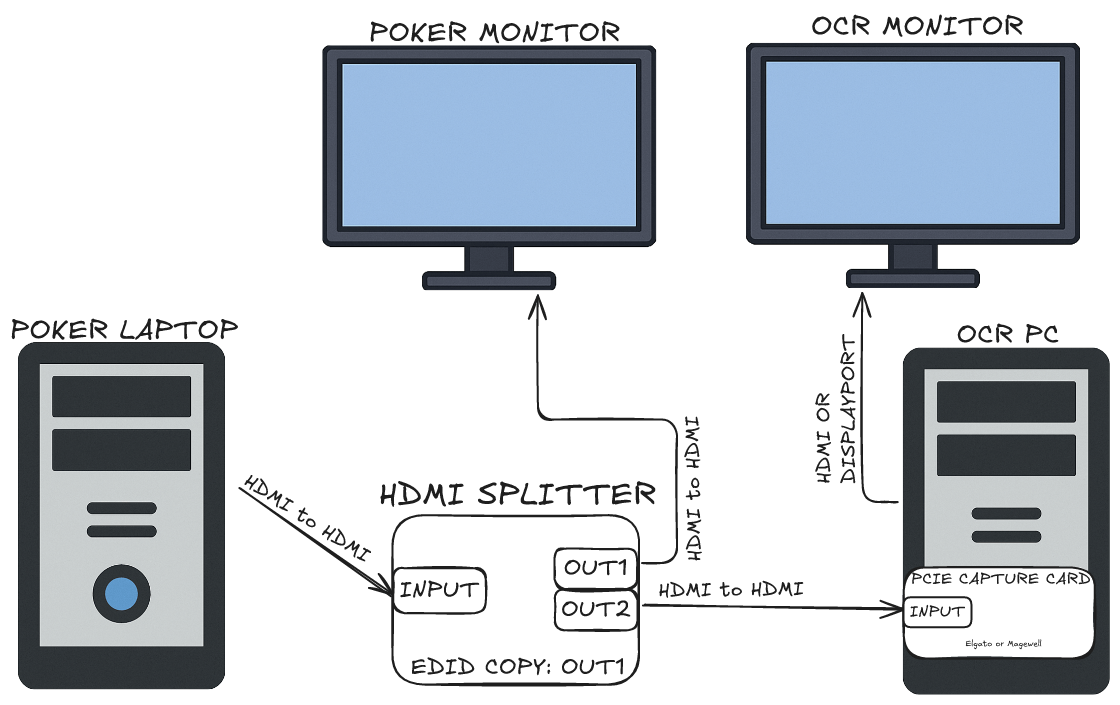
*Desktop setup with two monitors. The poker monitor and the OCR monitor are separate.*
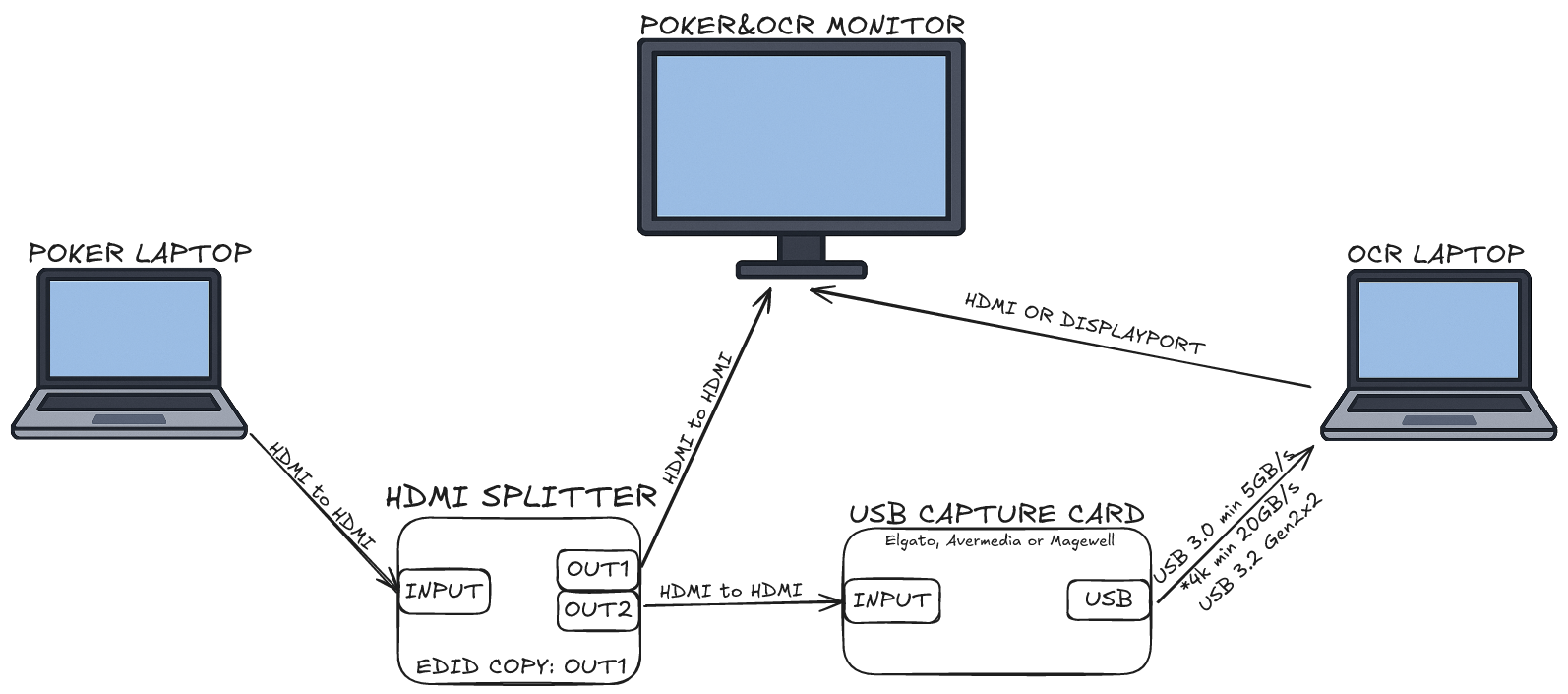
*Laptop setup with a USB capture card and one shared monitor.*
The full hardware list, including the splitter, capture card, cables and computer specifications, is in our [hardware requirements guide](https://setup.rta.poker/hardware/requirements/).
Why does the difference matter?
- With RTA you can ignore a suggestion, change a size or fold a hand you don't like. A bot can't.
- Someone who reads the overlay each hand sees how solver strategies mix across many spots. Someone running a bot sees only results.
- RTA needs a person at the table for the whole session. A bot doesn't, which is why bots can run around the clock.
Site rules and local laws
Poker sites set their own rules on outside tools and those rules differ from site to site. Laws differ between countries too. Before you use any tool, read the terms of the site where you play and check the rules where you live. Our [overview of jurisdictional differences](/blog/jurisdictional-differences-rta-legality) is a good place to start.
Quick reference
| Term | Meaning | | --- | --- | | Poker bot | A program that plays poker on its own, including the clicks, with no person making decisions. | | RTA | Real-time assistance. A display that shows a player a recommendation while they play. The player decides and clicks. | | Overlay | The small block drawn over the table that lists options and percentages. | | Mixed strategy | A solver answer that splits between actions, such as 61% small bet and 10% check. | | OCR | Optical character recognition. The software reads cards, bets and stacks from the video image. | | Capture card | Hardware that turns a video signal into data a second computer can read. |
Related reading
- [What is real-time assistance?](/blog/what-is-real-time-assistance)
- [Poker bot evolution and the rise of AI](/blog/poker-bot-evolution-rise-of-ai)
- [GTO with an RTA poker edge](/blog/gto-with-rta-poker-edge)